
How to Create a Stablecoin and Make It Successful: Launch, Liquidity, CEX Listing, and Real Adoption Guide
Because stablecoin launches now depend on trust as much as code, creating a stablecoin in 2025–2027 is not just a smart-contract task. Consequently, teams must treat launch planning as an operating system, not a one-time deployment. Therefore, founders need a peg design, audited infrastructure, reserve and redemption controls, compliance workflows, market-making coverage, CoinMarketCap and CoinGecko visibility, wallet price display, exchange-ready documentation, and a real reason for users to transact.
This guide is written for stablecoin founders, token launch teams, Web3 developers, liquidity managers, and altcoin projects preparing for a centralized exchange listing. As a result, you will learn how to create a stablecoin, choose the right model, defend the peg, prepare CEX listing materials, show a price in wallets such as Trust Wallet, and turn the token into payment infrastructure instead of a dormant balance. Furthermore, you can reuse the same discipline for altcoin launches that need stronger listing readiness.
What Is a Stablecoin?
In simple terms, a stablecoin is a crypto asset designed to track a reference value, usually one unit of fiat currency such as USD, EUR, BRL, or another national currency. Moreover, some stablecoins track commodities. Meanwhile, others use crypto collateral or algorithmic supply rules. For founders, however, the question is not only “how do I make a stablecoin?” Ultimately, the real question is: which promise are you making, and can your team keep it under stress? Likewise, every exchange, wallet, and payment partner will evaluate that promise before trusting the asset.
| Model | How it works | Best fit | Founder risk |
|---|---|---|---|
| Fiat-backed stablecoin | Tokens are issued against cash, bank deposits, short-term instruments, or similar liquid reserves. | Payments, CEX pairs, treasury movement, regulated corridors, merchant settlement. | Banking access, reserve management, legal obligations, transparency expectations. |
| Crypto-backed stablecoin | Users lock crypto collateral that exceeds issued supply. Liquidations protect solvency. | DeFi-native users, lending, on-chain treasury, permissionless minting. | Collateral volatility, oracle failures, liquidation cascades, capital inefficiency. |
| Commodity-backed stablecoin | Tokens represent a claim or economic exposure to assets such as gold or other commodities. | Inflation hedging, commodity settlement, specialized communities. | Custody, audits, redemption logistics, legal structure, price tracking. |
| Algorithmic stablecoin | Software expands or contracts supply, often using incentives, reserves, or companion assets. | Advanced teams with deep risk controls and a strong reason to avoid full collateralization. | Reflexive sell-offs, weak confidence loops, oracle manipulation, liquidity shocks. |
For this reason, most new projects should start with a transparent collateralized stablecoin unless they have a compelling reason not to. After all, collateral is easier for exchanges, merchants, payment partners, and users to understand. In addition, it creates a cleaner path for audits, reserve attestations, liquidity planning, and CEX due diligence. Consequently, collateralized launches usually face fewer explanation gaps during early partnerships.
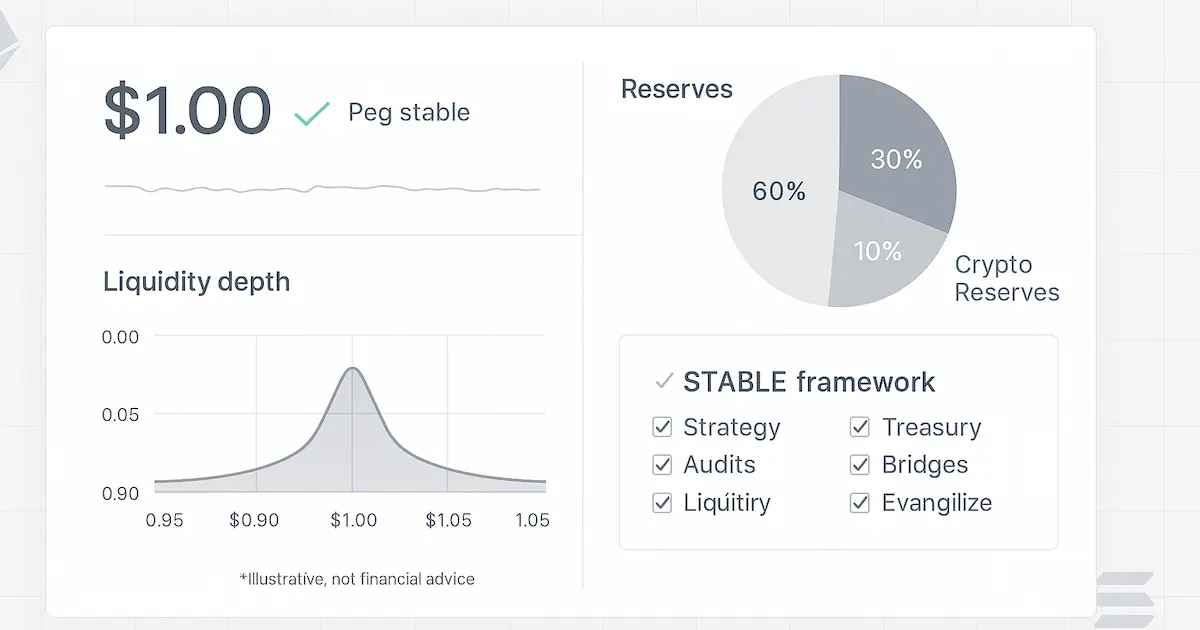
The STABLE Framework for Stablecoin Success
The original article used the STABLE framework. However, this upgraded version keeps the concept while making it more execution-ready for stablecoin issuers and altcoin teams preparing for token listing on CEX.
S — Strategy & model
First, define the peg, target users, use case, reserve policy, and stablecoin business model.
T — Technology & chain
Next, choose Ethereum, BNB Smart Chain, Solana, Tron, Polygon, Arbitrum, Base, or a phased multi-chain route.
A — Audits & compliance
Then, secure smart contracts, set KYC/AML flows for mint and redeem, document controls, and publish trust materials.
B — Bootstrap liquidity
Also, seed DEX pools, CEX books, market-maker inventory, redemption flows, and peg-defense playbooks.
L — Listings & integrations
Moreover, prepare for CMC, CoinGecko, Trust Wallet token price display, explorers, payment tools, and exchange listings.
E — Evangelize & expand
Finally, build demand through real payment corridors, wallet integrations, regional partners, case studies, and community trust.
First, use the framework in order. Otherwise, projects that skip liquidity, compliance, market-making, or tracker visibility often discover the gap later when exchanges reject the application, wallets show no price, users cannot redeem, or the peg trades with wide spreads.
Moreover, for broader token-growth execution, combine this stablecoin plan with Tokpie’s practical crypto growth playbook. In practice, stablecoin launch discipline and altcoin listing readiness overlap more than many founders expect. Therefore, use the framework as a shared operating checklist for product, legal, liquidity, and listing teams.
Why Stablecoin Launch Strategy Changed
At first, stablecoins were framed mainly as exchange settlement assets. However, that is no longer enough. Instead, the stronger launch thesis now includes regulatory readiness, payment integrations, regional currency strategy, merchant usage, CEX liquidity, and wallet discoverability. Moreover, the chart below shows why institutional and exchange attention tends to rise when the market sees more clarity around issuance and reserves. In turn, this makes regulatory preparation part of your distribution strategy.
Regulation as a listing-readiness signal
Regulatory clarity can unlock larger stablecoin flows
Quarterly adjusted stablecoin transfer value, shown in trillions of dollars
However, the lesson is not that regulation alone creates product-market fit. Rather, credible rules, transparent reserves, and operational controls reduce uncertainty for exchanges, payment companies, institutions, and enterprise buyers. Therefore, if you want a stablecoin CEX listing, prepare the legal memo, compliance matrix, audit reports, reserve policy, supply dashboard, and market-making plan before you submit the application.
In addition, stablecoin founders should avoid assuming that every market needs another USD token. Therefore, non-USD stablecoins can win where users think, earn, invoice, and pay in local currency. Besides, local-currency positioning can make your product easier to explain to merchants and payroll users.
Regional currencies can create differentiated demand
Non-USD stablecoins gained a higher post-MiCA baseline
Monthly transfer value for non-dollar stablecoins, in billions of dollars
For founders, this is a strategy signal. For example, a euro-backed, Brazilian-real-backed, or other local currency stablecoin may be stronger than another generic USD coin if your users settle invoices, payroll, merchant purchases, or domestic transfers in that currency. Still, a non-USD token needs the same fundamentals: reserves, redemptions, legal review, liquidity, exchange relationships, wallet metadata, and user demand. Consequently, regional differentiation should strengthen—not replace—operational discipline.
Stablecoin Model Selection: Collateralized vs Algorithmic
Because your model determines almost every later decision, treat it as a business architecture choice, not just a token design. Moreover, a CEX will ask how supply is created, how it is destroyed, what backs it, who controls privileged functions, and how the issuer handles stress. Therefore, model selection should be documented before exchange outreach begins.
Fiat-backed stablecoin
A fiat-backed stablecoin is usually the easiest model to explain to users and exchanges: one token targets one unit of fiat value, and circulating supply is matched by reserves. However, the founder challenge is not the ERC-20 or SPL token itself. Instead, the hard work is banking, custody, reserve eligibility, attestations, redemption SLAs, sanctions screening, and transparent operations. Accordingly, fiat-backed issuers should budget for operations and legal review as seriously as engineering.
Crypto-backed stablecoin
A crypto-backed stablecoin can be more DeFi-native. For example, users deposit collateral, the system issues stable tokens, and liquidations protect the protocol. Although this model can reduce bank dependency, it adds oracle risk and usually requires over-collateralization. Therefore, it is better for teams with strong risk engineering and an audience that understands collateral ratios.
Commodity-backed stablecoin
Commodity-backed models can work when users want exposure to a physical asset or when the stablecoin supports a narrow settlement use case. However, the hard parts are custody proof, redemption rights, insurance, audits, and price tracking. Meanwhile, CEXs will still want clean supply data, wallet support, and liquidity around the reference value. Therefore, commodity backing does not remove the need for exchange-grade market infrastructure.
Algorithmic stablecoin
An algorithmic stablecoin relies on software incentives, reserve mechanics, or a companion asset to stabilize supply and demand. Although it may look capital-efficient, it can become fragile when market confidence falls. Therefore, new founders should avoid algorithmic designs unless they can explain the stabilization logic, failure modes, liquidity backstop, oracle safeguards, and crisis process in plain language.
Stablecoin Business Model: How a Stablecoin Can Make Money
A good stablecoin business model funds operations without weakening the peg. By contrast, a bad model extracts value from users in ways that make the stablecoin less useful. Therefore, design monetization around trust, liquidity, and utility.
| Revenue path | How it works | Peg-friendly guidance |
|---|---|---|
| Reserve yield | The issuer earns income on eligible liquid reserves. | Keep reserve instruments conservative, liquid, documented, and aligned with legal advice. |
| Mint and redeem fees | Qualified users pay small fees to enter or exit supply. | Use simple fee tiers and avoid fees so high that users trade below peg instead of redeeming. |
| API and payment fees | Merchants, fintechs, or platforms pay for settlement, APIs, webhooks, and reconciliation tools. | Charge for value-added services, not basic token movement when that would hurt adoption. |
| Treasury services | Businesses use the stablecoin for treasury movement, payroll, vendor settlement, or liquidity management. | Offer reporting, permissions, limits, and compliance tooling that finance teams can actually use. |
| Card and payment integrations | Stablecoin balances connect to cards, checkout systems, invoices, or local payment rails. | Make settlement predictable and publish refund, dispute, and reconciliation flows. |
| B2B settlement products | Large buyers and suppliers settle faster than traditional rails in selected corridors. | Prioritize uptime, legal clarity, accounting exports, and liquidity in the corridor currency. |
| Exchange and liquidity partnerships | The stablecoin becomes a quote asset, settlement rail, or regional trading pair. | Never rely on fake volume. Exchanges value real demand, tight spreads, and clean documentation. |
However, avoid business models that pressure the peg: excessive transfer taxes, unclear reserve yield sharing, forced lockups, aggressive rehypothecation, or incentives that attract idle TVL but not real usage. Ultimately, for a stablecoin, reliability is the product. As a result, every revenue choice should make redemptions, liquidity, or user trust stronger.
Chain Selection: Where Should Your Stablecoin Live?
Because your chain choice shapes fees, speed, integrations, compliance controls, wallet support, CEX operations, and user behavior, treat it as a go-to-market decision. Therefore, do not choose a chain because it is fashionable. Instead, choose the network where your target users already trade, pay, bridge, and hold balances.
| Network | Why choose it | Watch-outs | Useful Tokpie resource |
|---|---|---|---|
| Ethereum | Deep DeFi, institutional familiarity, mature tooling, strong explorer coverage. | L1 fees can be high; many payment use cases need an L2 or strong UX layer. | Show market cap and token price on Etherscan-style explorers |
| BNB Smart Chain | Low fees, large retail footprint, fast deployment, broad BEP-20 wallet support. | Many tokens compete for attention; strong metadata and liquidity are essential. | Prepare a Binance-style listing path |
| Solana | High throughput, low fees, strong fit for consumer payments and app-native usage. | Requires Solana-specific operations, wallet UX, and monitoring discipline. | List a Solana token on CMC and CoinGecko |
| Tron | Popular for low-cost stablecoin transfers and emerging-market payment corridors. | Need clean TRC-20 metadata, wallet support, and corridor liquidity. | TRC-20 listing and integration guide |
| Polygon | Low fees, EVM tooling, consumer and DeFi integrations. | Liquidity can fragment unless you pick focused markets. | Polygon CMC and CoinGecko listing workflow |
| Arbitrum | Ethereum-compatible DeFi depth with lower costs than L1. | Bridge and canonical-address clarity matter for user trust. | Arbitrum listing guide |
| Base | Growing onchain app ecosystem, EVM compatibility, lower fees. | Young markets need careful liquidity planning and ecosystem partnerships. | Base token listing guide |
Canonical contracts, bridges, and liquidity fragmentation
A stablecoin can be native on one chain, native on multiple chains, bridged, or wrapped by third parties. However, each approach affects CEX listing review and wallet display. Therefore, publish a canonical address list on your website and sign it from official accounts. In addition, track every chain variant in your docs, CMC, CoinGecko, explorers, and wallet submissions.
Do not launch on five chains with no liquidity. Otherwise, multi-chain supply without market depth creates user confusion and weakens the peg. Instead, a better path is one primary chain, one primary DEX pool, one CEX order book, and a documented expansion plan. Then, add chains only when you can fund liquidity, market making, metadata, bridges, and support. Otherwise, expansion can weaken price confidence instead of improving reach.
Smart Contracts and Infrastructure
The contract is only one component of the stablecoin platform. In addition, you need dashboards, role management, monitoring, key custody, off-chain reconciliation, incident response, and support tooling.
EVM route: Ethereum, BNB Smart Chain, Polygon, Arbitrum, Base
On EVM chains, many teams begin with an ERC-20 or BEP-20 implementation using audited libraries. Next, common requirements include MINTER_ROLE, BURNER_ROLE, mint caps, role revocation, optional pausability, EIP-2612 permit support, and clear upgrade controls. Therefore, if you use a proxy, place upgrades behind a multisig, timelock, test suite, changelog, and public notice process.
Explorer visibility matters from day one. Therefore, verify contracts, publish source code, add token logos, and update metadata when supply, website, or links change. As a result, Tokpie’s guides on fast Etherscan and BscScan metadata updates and adding a token logo to Uniswap interfaces can reduce support friction after launch. Additionally, clean metadata helps users avoid fake contracts and spoofed assets.
Solana route: SPL token and program logic
On Solana, a simple fiat-backed stablecoin may use the SPL Token Program with controlled mint authority and, where legally required, freeze authority. However, more complex vault, collateral, or algorithmic systems may require a custom Rust program, often built with Anchor. Therefore, plan for concurrency, idempotent instructions, clear error messages, and continuous monitoring.
Wallet visibility is part of the launch. Because Solana users expect clean display in Phantom, Solflare, explorers, and portfolio tools, use a consistent token logo and official token metadata; Tokpie’s Solscan logo guide is useful for this step.
Access control and operational safety
- First, use multisig wallets for minting, upgrades, pause functions, and reserve-sensitive operations.
- Next, add timelocks for non-emergency changes so exchanges and users can review upgrades.
- Also, separate hot operational wallets from cold reserve and governance keys.
- Moreover, set mint limits, role-change alerts, and automatic monitoring for abnormal supply changes.
- Additionally, maintain dashboards for total supply, reserves, liquidity, spreads, redemptions, and wallet concentration.
- Finally, write incident playbooks for de-peg events, compromised keys, oracle failures, bridge failures, and false social-media rumors.
Before mainnet, shortlist auditors using Tokpie’s smart-contract audit provider overview, fix findings, rerun tests, and publish the audit report with a plain-English summary. Although exchanges will read the audit, users also need to understand what changed. Therefore, publish a short non-technical audit summary beside the full report.
Compliance and Trust Operations
This section is operational guidance, not legal advice. Because stablecoin rules vary by jurisdiction, model, user type, reserve asset, redemption process, and marketing activity, always work with qualified legal counsel before issuing, selling, redeeming, or listing a stablecoin.
Core trust package
| Document or control | Why it matters | What to publish or prepare |
|---|---|---|
| Legal review | Exchanges and payment partners need to understand your issuer, jurisdiction, rights, and obligations. | Legal memo, entity structure, terms, risk disclosures, eligible jurisdictions, counsel contact. |
| KYC/AML for mint and redeem | Primary issuance and redemption often require identity checks, sanctions screening, and transaction monitoring. | Onboarding flow, AML policy, sanctions process, escalation steps, audit trail. |
| Reserve policy | Users and exchanges must know what backs circulating supply. | Eligible reserve assets, custody banks, maturity limits, reconciliation cadence, attestations. |
| Freezing policy | Some issuers need controls for sanctions, court orders, or fraud events. | Legal triggers, approval workflow, transparency process, appeal path, reporting policy. |
| Transparency dashboard | Market participants need to verify supply, reserves, and liquidity health. | Total supply, reserve reports, redemptions, top liquidity venues, spreads, peg history. |
| Incident response | A fast and honest response can prevent panic during stress. | Status page, communication templates, signer list, playbooks, postmortem format. |
Trust is also a discoverability problem. For example, if your website, whitepaper, token logo, CMC page, CoinGecko page, explorer metadata, and wallet display do not match, users and exchange analysts will hesitate. Therefore, keep every public surface consistent. Otherwise, even a strong stablecoin can look risky because of mismatched public data.
Liquidity and Peg Defense: Make $1 Trade Like $1
Stablecoin liquidity is not a launch afterthought. Instead, it is the mechanism that lets users trust your peg before they ever redeem. CEXs evaluate liquidity because thin books create volatility, complaints, and reputational risk. As a result, a stablecoin that cannot trade near its reference value will struggle to get listed, even with strong technology. Therefore, peg-defense planning should start before any public launch campaign.
Build first markets deliberately
- First, pick one primary DEX pool and one primary CEX book instead of spreading liquidity everywhere.
- Next, use stable pairs such as your stablecoin/USDC, stablecoin/USDT, or a local fiat stablecoin pair when suitable.
- Then, seed visible depth around the peg, not only headline TVL far from the price users need.
- Also, choose AMM fee tiers and concentrated ranges appropriate for stable assets.
- Moreover, fund market-maker inventory on both bid and ask sides.
- Finally, publish pool addresses, trading pairs, redemption instructions, and support contacts.
Use venues your audience already trusts. For example, on EVM chains, Curve, Uniswap, PancakeSwap, and other DEXs may be relevant depending on the chain. Meanwhile, Solana teams should consider Solana-native venues and aggregators. For CEX strategy, compare venue fit with Tokpie’s centralized exchange listing comparison. Additionally, match each venue to your corridor, user base, and liquidity budget.
Market making for token listing and stablecoin stability
A professional stablecoin market making plan should define inventory, quoting ranges, spread targets, maximum exposure, rebalancing cadence, and emergency procedures. However, for a stablecoin, market makers are not just increasing volume. Instead, they are helping users enter and exit at predictable prices. Consequently, your market-maker brief should include peg expectations, not only volume targets.
| Liquidity control | Practical target | Why exchanges care |
|---|---|---|
| Spread bands | Define acceptable top-of-book and effective spread ranges around the peg. | Wide spreads make the asset look unstable and increase user complaints. |
| Depth around $1 | Show enough bid and ask liquidity for realistic user order sizes. | Exchanges want users to trade without extreme slippage. |
| Redemption flow | Provide clear mint/redeem thresholds, timing, fees, and support channels. | Redemption is the final peg defense when secondary markets move away from par. |
| Stabilization wallet | Pre-fund controlled inventory for stress periods and rebalance regularly. | Exchanges need confidence that the issuer can support markets during volatility. |
| AMM ranges | Keep concentrated liquidity active near the peg and rebalance when conditions change. | Inactive ranges create visible slippage and harm price confidence. |
| Oracle safeguards | Use resilient feeds, TWAPs, circuit breakers, and manipulation checks where applicable. | Bad price data can trigger liquidations, wrong minting, or panic. |
| Stress playbook | Document who acts, what gets paused, what gets disclosed, and when redemptions are prioritized. | CEX review teams prefer rehearsed operations over improvisation. |
Never use wash trading to impress exchanges, CMC, or CoinGecko. Otherwise, suspicious activity can damage listing applications, trigger compliance questions, and make real users distrust your project. Therefore, if you need help coordinating listing, liquidity, and tracker work, review Tokpie’s guide on outsourcing listing and liquidity operations. In short, clean execution beats inflated numbers.
CEX Listing Readiness for Stablecoins and Altcoins
Because the product makes a stability promise, a stablecoin issuer needs a stronger listing package than a normal token. Still, the same discipline helps any altcoin team preparing for a token listing on CEX: prove utility, prove legitimacy, prove liquidity, and prove that the market is not artificial.
What centralized exchanges generally review
First, exchanges review whether the project is legitimate, understandable, and safe for users. Therefore, prepare this trust layer before you discuss listing fees, launch timing, or trading pairs.
Project, legal, and contract review
| Listing area | What to prepare | Stablecoin-specific note |
|---|---|---|
| Real use case | Explain who uses the token and why demand should persist. | Payments, B2B settlement, merchant checkout, payroll, DeFi liquidity, or local-currency corridors are stronger than “another dollar token.” |
| Legal and compliance posture | Entity details, legal memo, eligible jurisdictions, KYC/AML process, sanctions screening, risk disclosures. | Include reserve structure, redemption rights, freezing policy, and attestation cadence. |
| Audited contracts | Audit reports, fixed issues, verified contracts, admin roles, multisig details, upgrade policy. | Mint/burn permissions, supply caps, pause functions, and reserve reconciliation require extra clarity. |
| Transparent token supply | Tokenomics, circulating supply, wallets, lockups, emissions, minting policy. | For stablecoins, supply should connect to reserves or collateral logic. |
| Clean website and docs | Whitepaper, FAQ, contact details, team information, terms, support links, brand assets. | Include redemption instructions and reserve dashboard links. |
Liquidity, visibility, and market demand review
| Listing area | What to prepare | Stablecoin-specific note |
|---|---|---|
| Liquidity and market making | Market-maker plan, inventory, spread targets, depth, CEX pair strategy, DEX pool addresses. | Show how the asset stays near the peg under normal and stressed conditions. |
| Active community | Social channels, support process, roadmap, announcements, engagement evidence. | Community should include actual users, not only airdrop hunters. |
| CMC and CG visibility | Tracker pages, correct pairs, exchange markets, logo, metadata, and volume consistency. | Stablecoin pairs must not show mismatched contracts or stale data. |
| Wallet price display | Trust Wallet token price, MetaMask display, explorer logos, portfolio tracker support. | Wallet users need to see name, logo, balance, and price without manual confusion. |
| Market demand and regional fit | Use data, user signups, corridors, merchant pilots, or DeFi integrations. | Regional stablecoins need local on/off-ramps and local liquidity. |
| Clean trading behavior | Avoid fake volume, wash trading, spoofing, and coordinated manipulation. | For stablecoins, artificial volume can undermine the credibility of the peg. |
Before applying to larger exchanges, some teams build a track record on smaller or specialized venues. Meanwhile, during that period, fix documentation, improve liquidity, collect payment-use cases, and clean up tracker data. In addition, Tokpie can support early altcoin listing, stablecoin pair setup, liquidity planning, and exchange-readiness workflows. Consequently, teams can close operational gaps before approaching larger venues.
CoinMarketCap, CoinGecko, Trust Wallet, and Explorer Visibility
Discoverability is not vanity. Instead, it is infrastructure for trust. If users cannot verify the token address, find the correct logo, see the price in wallets, or confirm trading pairs, they hesitate. Likewise, if exchange analysts see inconsistent information, your listing application slows down. Therefore, metadata management should have an owner, not an ad-hoc process.
CoinMarketCap and CoinGecko preparation
Before you list stablecoin on CoinMarketCap or list stablecoin on CoinGecko, launch real markets, verify supply data, and prepare a clean application package. Then, use exact contract addresses, consistent token name and symbol, official logo, website, whitepaper, socials, explorer links, trading pairs, reserve or collateral information, and support contacts. Consequently, Tokpie’s guides for CoinMarketCap listing and CoinGecko listing can help organize the submission.
Secondary trackers can also improve reach. After CMC and CG, consider relevant profiles on free coin trackers, LiveCoinWatch, CoinPaprika, CoinCodex, CoinCarp, and other data sites where your target users search.
Trust Wallet token price and wallet metadata
To improve the chance that a Trust Wallet token price appears correctly, keep tracker data, token contract, and liquidity consistent. Next, submit token logo and metadata carefully, maintain correct market pairs, and avoid contract-address confusion across chains. Moreover, Tokpie’s Trust Wallet token guide and Trust Wallet price-display workflow explain common fixes.
Do the same for MetaMask and other wallets. In addition, add or update logos, token lists, explorer metadata, and portfolio tracker data. Tokpie’s resources on MetaMask logo updates, MetaMask price display, and Trezor asset directory visibility can help reduce user friction. Furthermore, consistent wallet display reduces support tickets during the first weeks after listing.
Explorer metadata and support links
Explorer pages often become the first verification point for users, exchanges, OTC desks, and market makers. Therefore, keep logo, website, socials, verified source code, supply, and price fields aligned. For EVM projects, review Tokpie’s guide on token price and market cap on BscScan and Etherscan. Therefore, if you change contracts or metadata, update explorers quickly and announce the change in your docs.
Payment Utility: Why Stablecoins Are Becoming Infrastructure
Exchange volume is helpful, but it is not the same as payment demand. Instead, a stablecoin becomes durable when people use it for transfers, merchant payments, B2B settlement, payroll, treasury movement, remittances, DeFi, and card-linked spending. Therefore, CEX listing narratives are stronger when a project can show real utility, not only trading activity. In practice, payment evidence can become a stronger listing argument than short-term promotional volume.
Peer transfers are large, but merchant flows are rising
Payments are moving from peer transfers toward merchants
Adjusted stablecoin transaction counts by flow type, 2024 versus 2025, in millions
C2C activity remains the largest by transaction count, reaching 789.5M in 2025 in this dataset. However, the more important founder signal is C2B growth: consumer-to-business stablecoin transactions reached 284.6M in 2025. As a result, payment UX, merchant acceptance, refunds, receipts, reconciliation, and wallet integrations are no longer optional for a serious stablecoin launch. Consequently, product teams should test merchant flows before scaling exchange marketing.
Card-linked programs show demand for real-world spend
Card collateral shows stablecoins reaching everyday spend rails
Monthly collateral deposited for stablecoin-backed card programs, in millions of dollars
The card-program trend matters because it connects stablecoin balances to daily spending. However, the values above reflect collateral deposits backing card programs, not necessarily direct merchant spend one-for-one. Still, growth above $300M per month by early 2026 shows why stablecoin founders should design for card partners, issuing partners, KYC flows, merchant categories, chargeback policies, and reconciliation from the start. Additionally, Tokpie’s guide on bank card and Apple Pay purchase flows is useful when planning fiat-to-token access.
Velocity matters more than idle supply
A useful stablecoin turns over, not just sits in wallets
Adjusted monthly transfer value compared with circulating supply
Velocity rising from around 2.6x to around 6x suggests that existing stablecoin supply is being used more actively. Therefore, exchanges and payment partners care about this distinction. In practice, a large supply sitting idle is weaker than a smaller supply moving through real workflows with reliable liquidity and redemption. Therefore, measure usage quality, not only circulating supply.
Real-economy flows strengthen listing narratives
Real-economy payment value is large enough for exchange narratives
Estimated stablecoin payment flows by segment, in billions of dollars
B2B $90–140B
B2B $150–230B
Estimated real-economy stablecoin payment flows reached roughly $350B–$550B in 2025 in this chart. Meanwhile, B2B led by value, which makes sense because invoices, vendor settlement, treasury movement, and exchange corridors can involve large tickets. Therefore, founders can use this trend to build a stronger listing story: “our stablecoin is not only a trading pair; it solves settlement for a specific segment.”
Regional strategy matters
Regional demand is not evenly distributed
Origin share of estimated stablecoin payment value by region
63%
- Asia
$245B63% - North America
$95B24% - Europe
$50B13% - Rest of world
< $1B<1%
Asia accounts for about 63% of the regional payment volume shown here, with North America at about 24% and Europe at about 13%. Therefore, use regional data to choose exchange corridors, language support, wallet partnerships, compliance scope, on/off-ramps, and merchant pilots. Meanwhile, a stablecoin launch that works in Singapore, Hong Kong, or Japan may need a different partner stack than one targeting Europe, Brazil, or North America. Accordingly, regional launch plans should include local wallets, languages, exchanges, and compliance assumptions.
Local-currency stablecoins can win around local rails
BRLA shows why local fiat rails matter
Monthly transfer value for a Brazilian-real-backed stablecoin, in millions of dollars
BRLA transfer value rising to roughly $400M per month by early 2026 is a useful reminder: local fiat-backed stablecoins can grow when they connect to local rails, local payment behavior, and local liquidity. Therefore, a founder considering BRL, EUR, MXN, TRY, JPY, or another currency should study domestic payment habits before choosing chain, exchange, and wallet strategy.
Stablecoin adoption is becoming local, not only cross-border
Stablecoin payments are becoming more domestic
Monthly adjusted payment value split by domestic and cross-border flows
The domestic share in this chart rises from about half to nearly three-quarters. As a result, stablecoin go-to-market changes. However, cross-border remittance still matters, while local merchant payments, local payroll, local exchange pairs, local tax reporting, and local fiat exits can be just as important. Therefore, build for how people actually pay in the target market. Otherwise, even strong token infrastructure may fail to convert into daily usage.
Stablecoin Go-to-Market Strategy: Choose a Beachhead
Do not launch a stablecoin with the message “we are stable.” After all, that is a requirement, not a differentiation. Instead, choose one beachhead where your stablecoin is clearly better than existing rails, then use exchange listings and wallet visibility to support that use case.
| Beachhead | Why it can work | Launch assets to prepare |
|---|---|---|
| B2B settlement | Large invoices, treasury movement, and supplier payments need speed and reconciliation. | API, invoice workflow, compliance process, accounting exports, CEX liquidity. |
| Payroll | Remote teams and contractors need predictable value and fast settlement. | KYC process, local off-ramps, salary receipts, wallet education, support desk. |
| Merchant payments | C2B stablecoin transactions are growing and merchants care about lower fees and faster finality. | Checkout plugin, refunds, dispute policy, settlement reports, card or POS partners. |
| Remittances | Users need cheaper and faster transfers between currency corridors. | On/off-ramp partners, local exchange pairs, compliance workflow, clear fee comparison. |
| Local currency payments | Domestic payment share is rising; users may prefer their accounting currency. | Local fiat reserves, local legal review, regional wallets, domestic merchant pilots. |
| DeFi liquidity | Stable assets are useful in lending, stable swaps, collateral, and yield strategies. | Audits, oracle integrations, risk parameters, pool incentives, liquidation analysis. |
| Regional exchange corridors | CEX pairs can create reliable entry and exit for a specific user base. | Market maker, listing package, local pairs, tracker data, community support. |
| Wallet integrations | Users trust assets they can see clearly in their everyday wallet. | Token list submissions, logo, price feeds, support links, chain-specific metadata. |
First, pick one beachhead, prove usage, then expand. Otherwise, an unfocused stablecoin launch burns capital across too many chains, too many exchanges, and too many user stories. Therefore, focus creates the evidence you need for stronger CEX listing conversations.
Stablecoin Launch Runbook
0–2 Day: Mainnet, verification, and controlled access
- First, deploy final contracts and verify source code on explorers.
- Next, publish canonical contract addresses on the website, docs, socials, and pinned community posts.
- Then, run canary mint, transfer, burn, redeem, and wallet-display tests.
- Also, open mint/redeem to approved users under documented limits.
- Moreover, fund one DEX pool and one CEX order book if the CEX market is ready.
- Finally, activate alerts for mints, burns, role changes, large transfers, pool imbalance, and price deviation.
3–7 Day: Peg monitoring and support
- First, review spread, depth, slippage, redemption latency, and support tickets daily.
- Next, rebalance AMM ranges and CEX inventory according to the market-making plan.
- Then, publish a short status update with supply, reserves or collateral, liquidity venues, and known issues.
- Also, submit or update CMC, CoinGecko, explorer, and wallet metadata with exact addresses.
- Moreover, test wallet display in Trust Wallet, MetaMask, Phantom, Solflare, and relevant portfolio tools.
- Finally, run a live community session focused on redemption, peg policy, and launch lessons.
8–30 Day: Integrations and first real use case
- First, launch one merchant, payroll, remittance, B2B settlement, DeFi, or local-currency pilot.
- Next, move incentives from raw TVL to filled volume, real payments, or qualified integrations.
- Then, publish the first “State of the Peg” report covering supply, liquidity, redemption, spread, and incidents.
- Also, collect evidence for CEX applications: users, payment volume, integrations, liquidity, and clean trading history.
- Moreover, update CMC/CG and wallet pages after every meaningful venue or metadata change.
- Finally, prepare co-marketing with wallets, exchanges, merchants, or regional partners.
31–90 Day: Exchange readiness and institutional trust
- First, finalize reserve attestations or collateral reports and publish them on a stable URL.
- Next, refresh legal, compliance, and risk documents based on actual launch behavior.
- Then, negotiate deeper CEX liquidity, additional market-making coverage, and regional pairs.
- Also, run a de-peg drill, oracle-failure drill, compromised-key drill, and communications drill.
- Moreover, document product metrics such as active wallets, merchant volume, redemption latency, and support resolution time.
- Finally, prepare applications for larger exchanges only when liquidity, compliance, and demand are ready.
Common Mistakes That Hurt Stablecoin and Altcoin Listings
| Mistake | Why it hurts | Better approach |
|---|---|---|
| Launching without liquidity | Users see slippage and the peg looks weak. | Seed depth before promotion and fund market-maker inventory. |
| Listing on too many chains too early | Liquidity fragments and support becomes chaotic. | Start with one primary chain and expand with a liquidity plan. |
| Weak peg policy | Users do not know how price stability is maintained. | Publish redemption, reserve, market-making, and stress rules. |
| No redemption clarity | Users cannot exit at par when markets wobble. | Define who can redeem, minimum size, timing, fees, and support process. |
| No audit | Exchanges and institutions cannot trust mint/burn logic. | Complete audits, fix issues, and publish reports before scaling. |
| Poor CEX documents | Listing teams spend more time asking basic questions. | Prepare legal memo, token details, contracts, liquidity plan, market data, and team information. |
| Fake volume | It creates compliance risk and can damage credibility. | Use real market making, real users, and transparent reporting. |
| Ignoring wallet visibility | Users see missing logo, missing price, or wrong token data. | Submit metadata to wallets, explorers, CMC, CG, and token lists. |
| No clear use case | Exchanges see another token with no durable demand. | Pick a beachhead: payments, B2B, payroll, remittance, DeFi, or regional settlement. |
| No market maker | Order books become thin and volatile. | Define spread, depth, rebalancing, inventory, and emergency rules. |
| Unclear reserve policy | Stablecoin trust depends on backing clarity. | Publish eligible assets, custody approach, attestations, and dashboard data. |
| Overusing incentives | Mercenary capital leaves when rewards end. | Tie rewards to real volume, payments, integrations, and long-term usage. |
| Copying USDT or USDC without differentiation | Incumbents already have scale, liquidity, and trust. | Win a narrower market with better local rails, compliance, payments, or developer experience. |
Practical Checklists
Stablecoin creation checklist
- First, define peg currency, target market, and primary use case.
- Next, choose fiat-backed, crypto-backed, commodity-backed, or algorithmic design.
- Then, document reserve or collateral policy and redemption rules.
- Also, select chain and canonical contract structure.
- Moreover, build contracts with safe mint/burn, access control, monitoring, and audit coverage.
- Finally, prepare website, whitepaper, terms, risk disclosures, FAQ, and support process.
CEX listing readiness checklist
- First, maintain audited and verified smart contracts.
- Next, provide clear token supply, minting, burning, and reserve details.
- Then, prepare a legal memo and compliance overview.
- Also, document a market-making plan with spread and depth targets.
- Moreover, maintain active markets with real liquidity and clean trading behavior.
- Additionally, keep the website, docs, team profile, roadmap, and support channels current.
- Meanwhile, confirm CMC, CoinGecko, explorer, and wallet visibility.
- Finally, collect evidence of user demand, integrations, payment flows, or regional fit.
Liquidity readiness checklist
- First, fund and document the primary DEX pool.
- Next, keep the primary CEX book planned or live with market-maker coverage.
- Then, define spread targets and depth targets for realistic order sizes.
- Also, fund the stabilization wallet and control it with secure signers.
- Moreover, monitor and rebalance AMM ranges.
- Additionally, test the redemption process under normal and stressed conditions.
- Finally, keep slippage, top-of-book, volume, and liquidity dashboards live.
Trust and compliance checklist
- First, define the KYC/AML process for mint and redeem users.
- Next, implement sanctions screening and a suspicious-activity escalation process.
- Then, publish a freezing policy with legal triggers and approval workflow.
- Also, schedule reserve attestations or collateral reports.
- Moreover, operate a transparency dashboard for supply, reserves, liquidity, and redemptions.
- Additionally, maintain incident response and public communication playbooks.
- Finally, engage qualified legal counsel for target jurisdictions.
Wallet and tracker visibility checklist
- First, publish exact contract addresses for every chain.
- Next, keep token name, symbol, logo, website, and social links consistent.
- Then, submit or update CMC and CoinGecko pages.
- Also, check Trust Wallet, MetaMask, Solana wallets, and relevant token lists.
- Moreover, verify explorer pages with source code, logo, market cap, and price data where available.
- Additionally, list trading pairs and liquidity venues in docs.
- Finally, link support email, Telegram, Discord, and status page from all major profiles.
FAQ
Stablecoin launch, peg, and exchange questions
The smart contract can be inexpensive compared with the full launch. However, real costs include legal work, audits, reserve setup, banking or custody, compliance tools, market making, liquidity, exchange listing, tracker submissions, wallet visibility, and ongoing operations. Therefore, budget for the full trust and distribution stack, not only development.
Not always on day one. However, a CEX listing can improve liquidity, price discovery, redemption access, and user confidence. Therefore, stablecoins targeting payments, regional corridors, or trading pairs usually benefit from at least one credible centralized exchange market.
Use a credible reserve or collateral model, clear redemption at par, deep liquidity, professional market making, oracle safeguards, transparent dashboards, and rehearsed stress playbooks. In practice, a peg is defended through operations, not only code.
Start with user behavior. Although USD stablecoins can work well for trading, savings, and global settlement, a local currency stablecoin may be stronger when users invoice, pay salaries, spend, or settle domestically in that currency.
Exchanges generally review legal posture, compliance controls, audited contracts, reserve or collateral policy, redemption process, liquidity, market-making plan, team credibility, real demand, tracker visibility, wallet display, and trading-quality risks. Moreover, stablecoin issuers should prepare reserve and redemption evidence early.
CoinMarketCap, CoinGecko, wallet, and token-listing questions
Prepare exact contract addresses, official logo, website, whitepaper, explorer links, active trading pairs, liquidity evidence, volume data, supply information, social links, and support contacts. Then, submit forms only after markets and metadata are consistent.
Keep CMC or other supported price data aligned with the correct contract, maintain active markets with real liquidity, submit token logo and metadata, and ensure every chain variant uses the correct address. Otherwise, mismatched contracts can stop prices from appearing.
The best chain depends on the user base. For example, Ethereum and L2s are strong for DeFi and institutional integrations. Meanwhile, BNB Smart Chain and Tron can suit low-cost transfers, while Solana can fit high-throughput consumer payments. Therefore, multi-chain launches should wait until liquidity and support are ready.
Yes. Altcoin teams also need audited contracts, clear token supply, liquidity, market making, CMC and CoinGecko visibility, wallet metadata, explorer information, community proof, real use case, and clean trading behavior. In addition, they should avoid fake volume and inconsistent contract metadata.
Trading volume comes from buying and selling on exchanges or DEXs. By contrast, payment volume reflects transfers for real-world settlement, such as merchants, payroll, B2B invoices, remittances, or treasury movement. Exchanges may value both, but payment volume is stronger evidence of utility.
Conclusion: Build the Stablecoin Like a Product, Not Just a Token
To create a stablecoin that survives beyond launch week, build for trust first. Next, choose a model users can understand. Then, keep reserves or collateral transparent. After that, audit the contracts and protect privileged roles. Moreover, publish redemption rules, fund liquidity, and work with market makers. Before scaling, prepare exchange-ready documents and keep CMC, CoinGecko, explorers, and wallets consistent. Finally, prove real utility through payments, DeFi, B2B settlement, payroll, merchant flows, or regional corridors.
The same approach helps altcoin teams preparing for a centralized exchange listing. After all, CEXs do not only list code; they list markets, teams, communities, documentation, liquidity, and credible demand. Therefore, a token with strong visibility, clean metadata, real use, and disciplined market making is easier to evaluate and easier for users to trust.
Need exchange-readiness, liquidity, and visibility support?
Tokpie helps crypto teams prepare for token listings, stablecoin listings, liquidity planning, market-making coordination, CMC and CoinGecko visibility, Trust Wallet and explorer metadata, and CEX access. Therefore, use Tokpie as a practical partner when you need a launch path that connects contracts, markets, wallets, and real users.
Next, explore listing and liquidity support, or alternatively review centralized exchange listing options.